

AI-Native Development Platforms vs. Traditional DevOps: Accelerating Software Delivery in 2026
AI-Native Development Platforms vs. Traditional DevOps: Because Your Pipeline Deserves Therapy in 2026

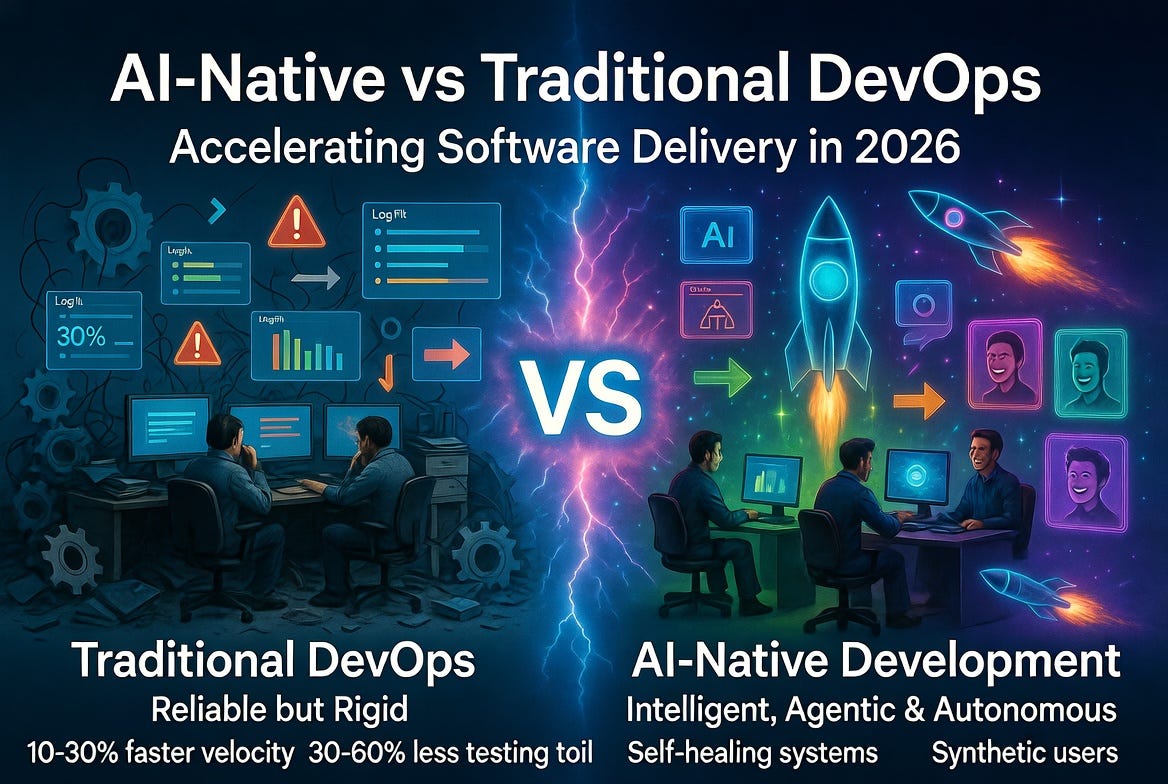
In 2026, software delivery isn’t just faster—it’s fundamentally different. Traditional DevOps, built on scripted pipelines, manual oversight, and reactive fixes, still powers many organizations. But AI-native development platforms are rewriting the rules. These platforms embed intelligence directly into every layer of the software development lifecycle (SDLC), turning code generation, testing, and operations into autonomous, adaptive processes.
The result? Teams using mature AI-native systems report 10-30% gains in code velocity and 30-60% reductions in testing overhead, while cutting release cycles dramatically. High-growth organizations are seeing up to 67% shorter cycles and fewer incidents. The gap isn’t theoretical—it’s measurable, and it’s widening fast.
Traditional DevOps: Reliable, But Rigid
Traditional DevOps relies on tools like Jenkins, Ansible, and rule-based CI/CD pipelines. It excels at consistency: automated builds, infrastructure-as-code, and standardized deployments. Monitoring tools alert teams to issues, and human engineers step in to diagnose and fix them.
Limitations in 2026:
Reactive, not predictive — Failures happen first; then alerts fire.
Manual bottlenecks — Code reviews, test writing, and incident triage still eat developer time.
Scalability struggles — Microservices, cloud-native sprawl, and AI-generated code volumes overwhelm static scripts.
Toil-heavy — Engineers spend 30%+ of their time on repetitive tasks, leading to burnout.
It’s solid for stable environments but creaks under the velocity demanded by modern digital businesses.
AI-Native Development Platforms: Intelligent by Design
AI-native platforms treat AI as core infrastructure, not an add-on. They use multi-agent systems, predictive analytics, and generative models to plan, execute, and self-optimize across the entire SDLC. Platforms like those built around GitHub Copilot Workspace, Cursor, and emerging agentic frameworks go beyond suggestions—they autonomously handle multi-file changes, security fixes, and even deployment decisions.
Key differences:
Predictive vs. reactive — AI spots anomalies before they become outages.
Agentic vs. scripted — Autonomous agents reason, plan, and act within guardrails.
Intent-driven vs. implementation-heavy — Developers describe outcomes in natural language; AI handles the “how.”
Head-to-Head: Three Game-Changing Areas
1. Code Generation: From Autocomplete to Agentic Autonomy
Traditional DevOps uses basic scripting and occasional Copilot-style autocomplete. AI-native platforms deploy full agentic coding: tools like Claude Code (now the most-used AI coding assistant), Cursor 2.0 (running multiple parallel agents), GitHub Copilot Workspace, and Lovable/Replit agents generate, edit, and verify entire features from natural-language prompts.
Impact in 2026:
Early adopters see initial 10-20% slowdowns during workflow adjustment, but mature teams gain 10-30% overall velocity.
AI handles boilerplate, bug fixes, documentation, and even security patches autonomously.
Human engineers shift to intent, architecture, and verification—seniority now means managing agent swarms, not writing every line.
2. Testing: Synthetic Users Replace Weeks of User Research
Traditional testing relies on manual scripts, real-user beta groups, and slow recruitment. AI-native platforms introduce synthetic users—AI-generated personas that simulate real behavior, preferences, and decision-making.
How it works:
Multi-agent systems create profiles based on demographics, psychographics, and past data (using models like OCEAN personality frameworks). These “users” interact with prototypes, websites, or apps in minutes, flagging usability issues, concept feedback, and edge cases.
Benefits:
Concept and prototype validation in hours instead of weeks.
Parallel testing of multiple flows or messaging variants.
Early catch of obvious friction—before real users ever see it.
Not a full replacement (real users still validate), but ideal for iteration and narrowing options.
Teams using synthetic users report dramatically faster UX validation and more confident launches.
3. Agentic SRE: Self-Healing Systems and Autonomous Operations
Traditional SRE depends on static alerts, runbooks, and on-call engineers. Agentic SRE deploys AI agents that detect, diagnose, remediate, and verify fixes autonomously.
Real-world examples in 2026:
Tools like New Relic SRE Agent, Azure SRE Agent, StackGen’s Aiden AI, and multi-agent systems from OpsWorker or Komodor orchestrate across metrics, logs, topology, and runbooks.
Agents roll back deployments, apply patches, draft RCAs, and notify teams—reducing MTTR by 40-60% and eliminating alert fatigue.
Self-healing infrastructure becomes standard: agents reason over context, test hypotheses in parallel, and act within policy guardrails.
Engineers move from firefighting to defining intent and guardrails.
A Practical Guide for IT Teams: Upskilling and Integrating Domain-Specific LLMs
Transitioning isn’t about replacing people—it’s about augmenting them. Here’s a proven playbook many organizations are following in 2026:
Start with High-Impact Use Cases Pick one bottleneck (code generation, testing, or incident response) and pilot AI-native tools there. Measure baseline metrics: cycle time, defect rates, MTTR.
Build or Fine-Tune Domain-Specific LLMs (DSLMs) General models hallucinate in specialized contexts. DSLMs are fine-tuned on your internal codebases, docs, policies, and historical data.
Use techniques like LoRA/QLoRA for efficient adaptation.
Combine with RAG (retrieval-augmented generation) for grounded answers.
Tools like Claude Code or enterprise platforms make this accessible without massive GPU farms. Result: 50% lower costs, higher accuracy, and compliance built-in.
Upskill Your Workforce—AI-Native, Not Just AI-Aware
Foundational fluency: Prompt engineering, agent orchestration, and verification skills for all engineers.
Role-specific tracks: Developers learn agent management; SREs focus on policy-as-code and guardrails; QA shifts to synthetic user orchestration.
Platform engineering first: Build internal developer platforms (IDPs) with golden paths, self-service AI agents, and built-in safety nets.
60-day sprints work: Many teams upskill 500+ engineers in weeks using contextual, hands-on training—no downtime required.
Implement Guardrails and Governance
Human-in-the-loop for critical decisions.
Policy-as-code, automated security scans, and audit trails.
Monitor AI ROI: velocity gains vs. rework/burnout.
Measure and Iterate Track productivity, quality, developer satisfaction, and business outcomes. Mature teams see the “AI velocity paradox” resolved when downstream processes (testing, deployment) modernize alongside code gen.
The 2026 Reality: Choose Your Pace
Traditional DevOps isn’t obsolete—it’s the reliable foundation. But AI-native platforms are the accelerator, delivering faster, safer, and more resilient software delivery. Organizations that treat AI as infrastructure—embedding agents, synthetic testing, and domain-specific intelligence—aren’t just keeping up; they’re pulling ahead.
The question isn’t whether AI will transform your delivery pipeline. It’s whether your team will lead the shift or scramble to catch up.
Ready to build your AI-native practice? Start small, measure relentlessly, and empower your people to manage the agents. The future of software delivery isn’t coming—it’s already here.